


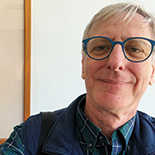
 As a doctoral student in chemistry during the early 1980s, David Beratan (PhD ’86) recalls a Caltech community that was highly collaborative and creative. The chair of the Division of Chemistry and Chemical Engineering at that time was Harry B. Gray, a role he held prior to being named the founding director of the Beckman Institute. Gray was instrumental in attracting such faculty as Rudy Marcus, John Hopfield, Ahmed Zewail, and Bob Grubbs to the Institute. All four would become Nobel laureates, a feat that Beratan describes as astounding.
“The Caltech faculty that Harry recruited were at their peaks of creativity during this time, and interactions among the faculty taught me the power of cross-disciplinary interaction and collaboration,” says Beratan, who states he joined Hopfield’s nascent group largely because the physicist seemed to be having the most fun with his research.
Beratan is now the R.J. Reynolds Distinguished Professor of Chemistry at Duke University, where he has spent the last 25 years of his career. Much like his Caltech mentors, he embraces an interdisciplinary approach to his research, holding professorships in both biochemistry and physics. He is also affiliated with Duke’s programs in computational biology and bioinformatics as
well as structural biology and biophysics.
Still inspired by those early years in Pasadena, the Caltech alumnus has made plans to create the Beratan Family Graduate Fellowship through a bequest to the Institute.
“The generous mentoring, off-scale creativity, sense of optimism, curiosity, and engagement conveyed by these faculty were transformative,” says Beratan. “While I learned some great science and worked on terrific projects that launched my career, it was the positive engagement and generosity of the faculty, and the examples of fearless questioning associated with impossibly difficult scientific challenges, that changed my life.”
Nothing Is Beyond Reach
When Beratan learned that Hopfield was awarded the Nobel Prize in Physics in 2024 in recognition of his pathbreaking work in neural networks, the former student was over the moon. He described Hopfield as a profoundly insightful scholar as well as a kind and generous mentor.
“John’s door was always open, and he was never too busy to speak with us,” says Beratan.
Hopfield illustrated for Beratan and his fellow students that no scientific question was out of bounds for investigation and human reasoning. “Nothing is beyond reach,” recalls Beratan.
He also encouraged his students to pursue life beyond campus. “When he spotted us in the lab on the weekends, he scolded us and suggested that we spend that time with our families,” says Beratan.
Investing in All Career Stages
Reflecting on his own career, Beratan attributes some of his most exciting moments at Duke to
his interactions with students. “I have been fortunate to have creative, engaged, and passionate students who have made
remarkable contributions,” he says.
Beratan hopes that investing in Caltech graduate students will support the process of knowledge creation and data-driven decision-making that he views as instrumental in advancing the world forward.
“We really can’t do our work without excellent graduate students,” says Beratan. “We worry about how we’re going to recruit the best students and support them over four or five years. I think this kind of unrestricted support for graduate students is just critical for the enterprise of discovery and science.”